Huntingtin antibody
Principal name
Huntingtin antibody
Alternative names for Huntingtin antibody
Huntington Disease Protein, HD, IT15, HTT
Ncbi ID
Available reactivities
Available hosts
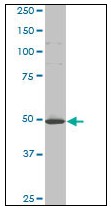
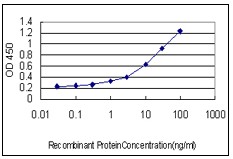
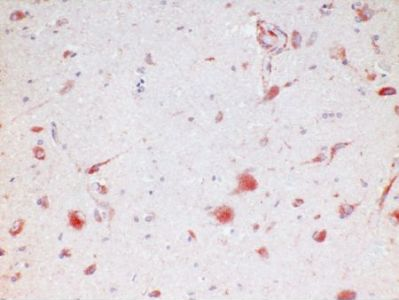
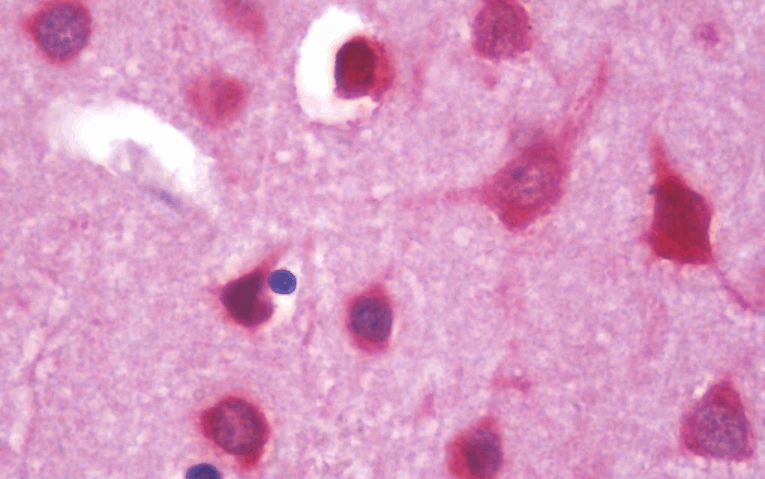
Available applications
Enzyme Immunoassay (E), Western blot / Immunoblot (WB), Frozen Sections (C), Immunoprecipitation (IP), Paraffin Sections (P), Immunocytochemistry/Immunofluorescence (ICC/IF)
Background of Huntingtin antibody
Huntingtin is a disease gene linked to Huntington's disease, a neurodegenerative disorder characterized by loss of striatal neurons. This is thought to be caused by an expanded, unstable trinucleotide repeat in the huntingtin gene, which trans lates as a polyglutamine repeat in the protein product. A fairly broad range in the number of trinucleotide repeats has been identified in normal controls, and repeat numbers in excess of 40 have been described as pathological. The huntingtin locus is large, spanning 180 kb and consisting of 67 exons. The huntingtin gene is widely expressed and is required for normal development. It is expressed as 2 alternatively polyadenylated forms displaying different relative abundance in various fetal and adult tissues. The larger transcript is approximately 13.7 kb and is expressed predominantly in adult and fetal brain whereas the smaller transcript of approximately 10.3 kb is more widely expressed. The genetic defect leading to Huntington's disease may not necessarily eliminate transcription, but may confer a new property on the mRNA or alter the function of the protein. One candidate is the huntingtin-associated protein-1, highly expressed in brain, which has increased affinity for huntingtin protein with expanded p olyglutamine repeats. This gene contains an upstream open reading frame in the 5' UTR that inhibits expression of the huntingtin gene product through translational repression. [provided by RefSeq]
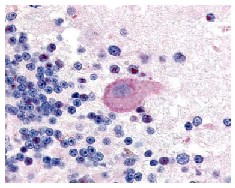
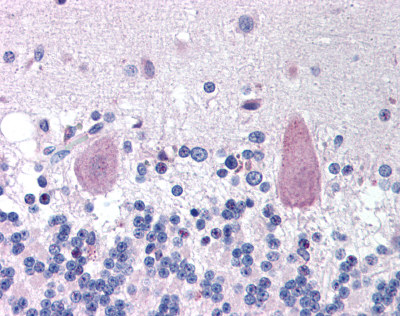
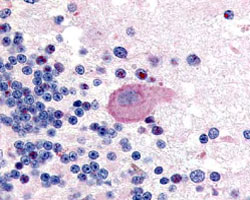
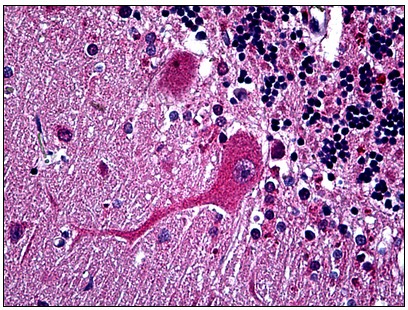
Antigen distribution: Nucleus but also cytoplasmic expression in most tissues. Highest levels in neurons and paneth cells in gastrointestinal tract. Distinct granular expression pattern in several glandular epithelia.
General readings
1. Trushina,E. et al. (2004) Mutant huntingtin impairs axonal trafficking in mammalian neurons in vivo and in vitro. Mol. Cell. Biol. 24 (18), 8195-
8209.
2. Lee,W.C., Yoshihara,M. and Littleton,J.T. (2004) Cytoplasmic aggregates trap polyglutamine-containing proteins and block axonal transport in
a Drosophila model of Huntington's disease. Proc. Natl. Acad. Sci. U.S.A. 101 (9), 3224-3229.
3. Zainelli,G.M., Ross,C.A., Troncoso,J.C., Fitzgerald,J.K. and Muma,N.A. (2004) Calmodulin regulates transglutaminase 2 cross-linking of huntingtin. J. Neurosci. 24 (8), 1954-1961.




- Quick-Filters:
- Overnight Delivery (remove)
Primary Antibodies
| Catalog No. | Host | Iso. | Clone | Pres. | React. | Applications | |
|---|---|---|---|---|---|---|---|
| AB0080-20 | Huntingtin (85-200) antibody |
||||||
 |
Goat | IgG | Aff - Purified | Can, Hu, Mky, Ms, Rt | C, ICC/IF, P, WB |
20 µl /
$50.00
|
|
| SICGEN | |||||||
| AB0080-200 | Huntingtin (85-200) antibody |
||||||
|
Goat | IgG | Aff - Purified | Can, Hu, Mky, Ms, Rt | C, ICC/IF, P, WB |
0.6 mg /
$280.00
|
|
| SICGEN | |||||||