PAX1 antibody
Principal name
PAX1 antibody
Alternative names for PAX1 antibody
Pax-1, HUP48, Paired box protein Pax-1
Ncbi ID
Available reactivities
Available hosts
Available applications
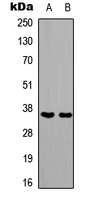
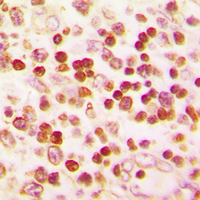
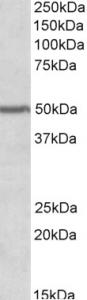
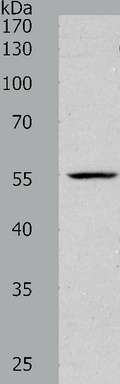
Western blot / Immunoblot (WB), Paraffin Sections (P), Flow Cytometry (F), Enzyme Immunoassay (E)
Background of PAX1 antibody
Pax proteins are a family of transcription factors with a highly conserved paired domain; many members also contain a paired-type homeodomain and/or an octapeptide. strate that the transcriptional competence of a subfamily of Pax proteins is determined by a C-terminal regulatory module composed of activating and inhibitory sequences. Nine mammalian Pax genes are known and classified into four subgroups: Pax-1/9, Pax-2/5/8, Pax-3/7, and Pax-4/6. Most of these genes are involved in nervous system development. The homeobox, which encodes the DNA-binding homeo domain, is a DNA sequence motif present in several Drosophila developmental genes; it has been used to identify many homologous genes involved in mammalian development. The paired box is another conserved sequence motif, first identified in the paired (prd) and gooseberry (gsb) Drosophila homeo domain genes. The amino-terminal region of the paired domain, including one of the three predicted alpha-helices, is necessary and sufficient for binding. There are several members in the PAX family including PX1-PX11). Single amino acid substitution mutation in PAX1 causes formation of the mouse skeletal mutant undulated (un) (1).
Pax-1 is necessary for normal vertebral column formation along the entire axis, although the severity of the phenotype is strongest in the lumbar region and the tail. Pax-1-deficient mice lack vertebral bodies and intervertebral discs (2). The pattern-forming event of kidney tubulogenesis is initiated by the inductive transition of mesenchymal cells to epithelial phenotype; a transition that is critically dependent on the regulated expression of the developmental control gene, Pax-2. Pax2/5/8-related genes (egl-38 and pax-2) influence both somatic and germline cell death in C. elegans. Pax proteins act as transcriptional regulators of ced-9, the C. elegans bcl-2 gene. These results identify a mechanism for Pax2/5/8-mediated regulation of cell death, and underscore the importance of transcriptional regulation of core apoptotic pathway genes in influencing cell survival. Pax-6 is involved in the specification of subtypes of hindbrain motor neurons, presumably through the regulation of Islet-2 and Wnt-7b expression (3). Pax 8 gene has a size of approximately 26 kb and contains the coding sequence for mRNA in 12 exons (4).
General readings
Vatanavicharn,N., (2007) Am. J. Med. Genet. A 143 (19), 2292-2302

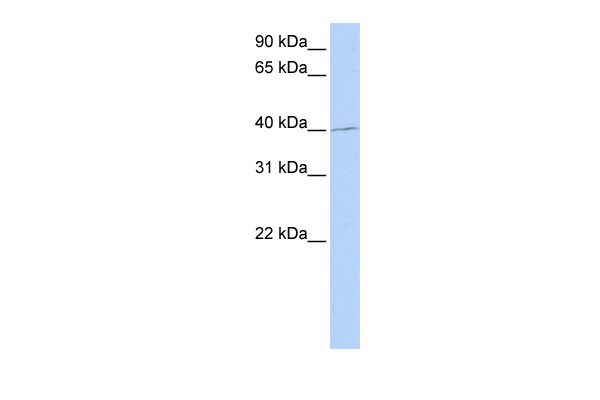
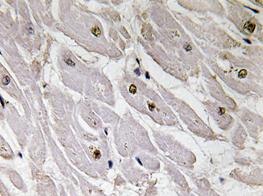

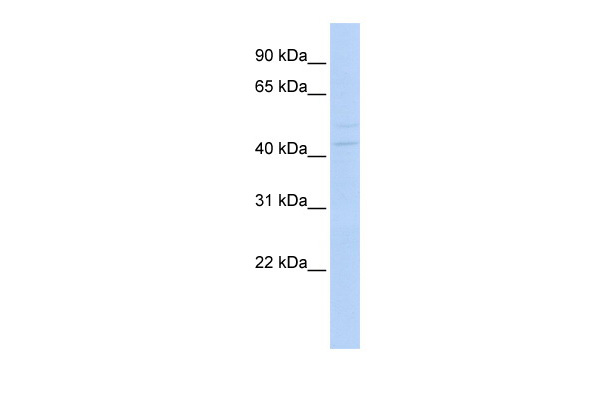
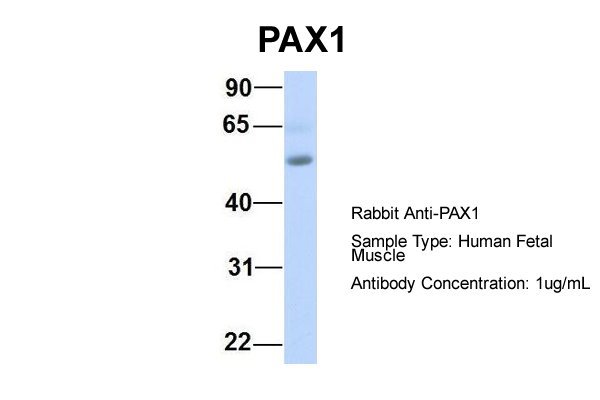
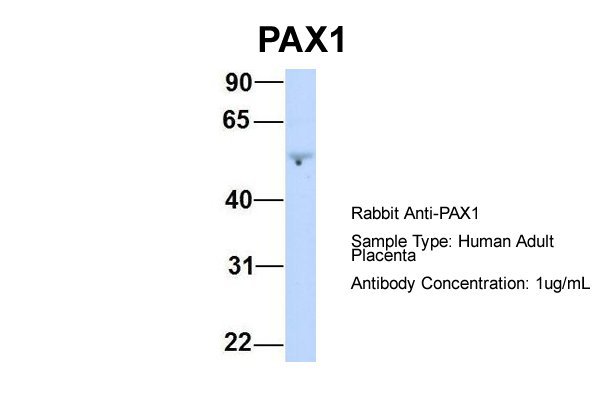
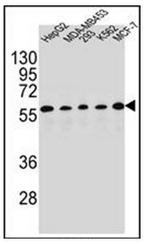
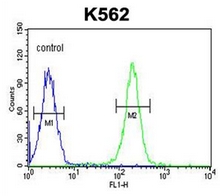
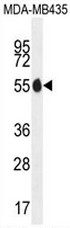


Primary Antibodies
| Catalog No. | Host | Iso. | Clone | Pres. | React. | Applications | |
|---|---|---|---|---|---|---|---|
| TA311353 | PAX1 (318-239) antibody |
||||||
| Goat Anti-PAX1 (aa318-329) Antibody | |||||||
 |
Goat | Aff - Purified | Bov, Can, Hu, Ms, Por | E, WB |
0.1 mg /
$360.00
|
||
| OriGene Technologies, Inc. | |||||||
| TA321752 | PAX1 antibody |
||||||
| Anti-PAX1 Rabbit Polyclonal Antibody | |||||||
 |
Rabbit | IgG | Purified | Hu, Ms, Rt | E, WB |
0.1 ml /
$335.00
|
|
| OriGene Technologies, Inc. | |||||||
| AP20616PU-N | PAX1 antibody |
||||||
 |
Rabbit | Aff - Purified | Hu | P, WB |
0.1 mg /
$370.00
|
||
| OriGene Technologies GmbH | |||||||
 +1 additional image +1 additional image |
|||||||
| AP53177PU-N | PAX1 (C-term) antibody |
||||||
 |
Rabbit | Ig | Aff - Purified | Hu | F, WB |
0.4 ml /
$415.00
|
|
| OriGene Technologies GmbH | |||||||
| +1 additional image |
|||||||
| AP53178PU-N | PAX1 (N-term) antibody |
||||||
 |
Rabbit | Ig | Aff - Purified | Hu | WB |
0.4 ml /
$415.00
|
|
| OriGene Technologies GmbH | |||||||
Lysates
| Catalog No. | ||
|---|---|---|
| LY401864 | PAX1 overexpression lysate |
|
 |
0.1 mg /
$495.00
|
|
| OriGene Technologies, Inc. | ||
| LY432289 | PAX1 overexpression lysate |
|
|
0.1 mg /
$315.00
|
|
| OriGene Technologies, Inc. |