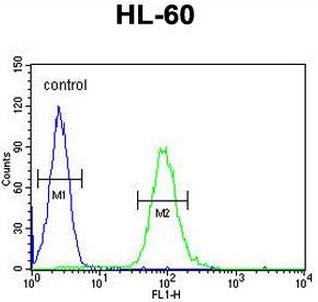
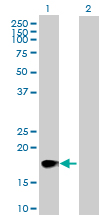
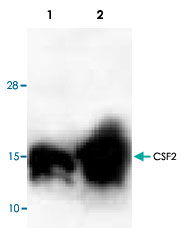
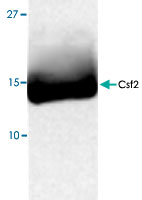
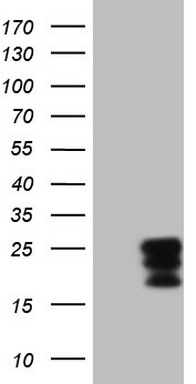
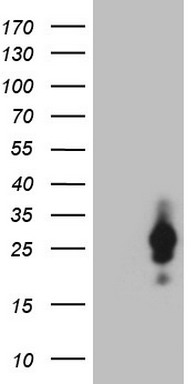
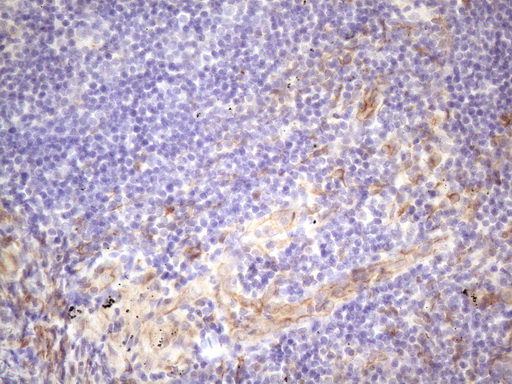
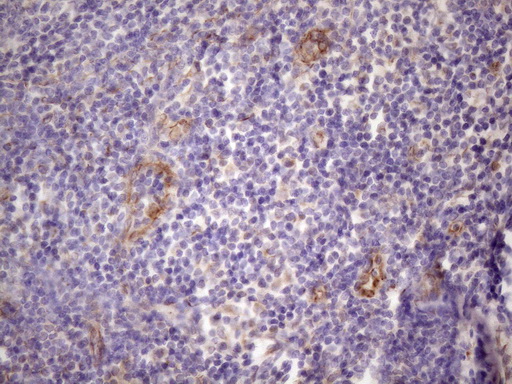
GM-CSF antibody
Principal name
GM-CSF antibody
Alternative names for GM-CSF antibody
CSF2, GMCSF, Sargramostim, Molgramostin, Granulocyte-macrophage colony-stimulating factor, Colony stimulating factor 2
SwissProt ID
O62757 (Felca), P01587 (Mouse), P04141 (Human), P11052 (Bovin), P28773 (Sheep), P48749 (Canfa), P48750 (Rat), Q29118 (Pig), Q60481 (Cavpo)
Ncbi ID
NP_000749.2, NP_000749, XP_001074265, NP_034099, 9606, 10090, 10116, NP_034099.2, XP_001074265.1, NP_776452.1, NP_001009805.1, NP_ 000749, AAI14000.1, NM_000758, NP_446304, NM_009969, NM_053852
Available reactivities
Available hosts
Available applications
Frozen Sections (C), Enzyme Immunoassay (E), Functional assay (FN), Western blot / Immunoblot (WB), ELISA (detection) (E(detection)), Immunocytochemistry/Immunofluorescence (ICC/IF), Flow Cytometry (F), Radioimmunoassay (R), Neutralisation (NEUT), Paraffin Sections (P), ELISA (capture) (E(capture)), Immunoprecipitation (IP)
Background of GM-CSF antibody
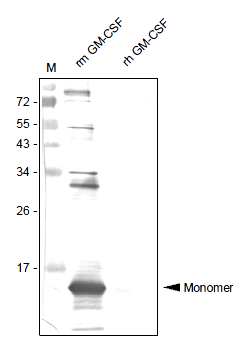
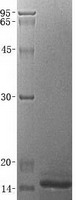
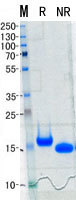
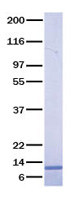
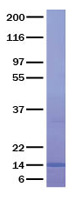
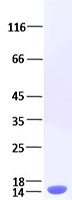
Granulocyte-macrophage colony stimulating factor (GM-CSF) regulates hematopoiesis, cell migration and immunity. GM-CSF is crucial for the growth and development of granulocyte and macrophage progenitor cells particularly during host defence and inflammatory reactions. GM-CSF is glycosylated at two N-linked and several O-linked sites. Glycosylation of GMCSF is important as it can affect pharmacokinetics, receptor affinity, biological activity, in vivo clearance rates and immunoreactivity. Patients receiving human recombinant GM-CSF commonly develop antibodies that recognize recombinant human GM-CSF produced in yeast (sargramostim) and E. coli (molgramostin), which exhibit glycosylation patterns that are distinct to the native human glycosylation. This is a HCX protein. HCX Expression System Details HCX proteins mimic the proteins in the human body because they are expressed from human, rather than animal, insect or bacterial cells. This process gives them human post-translational modifications. Recombinant DNA techniques allow a human protein with the correct amino acid sequence to be expressed in a non-human cell line. However, non-human cells lack the appropriate cellular machinery, such as specific glycosyltransferases, necessary to produce the correct human post-translational modifications of a protein. An extreme example is seen in E. coli cells, which produce recombinant proteins with no glycosylation, as the above figure illustrates. Rodent and yeast cells are able to glycosylate proteins, but they are still different from glycosylation in human cells. Expression System Resultant Proteins Human (e.g. K562, HEK293) Correct amino acid sequence Human post-translational modifications Rodent (e.g. CHO, NSO) Correct amino acid sequence Some natural glycosylation - not human-like Yeast (e.g. Pichia) Correct amino acid sequence Some natural glycosylation - not human-like E.Coli Correct amino acid sequence No PTMs Although there have been significant attempts to make non-human cell derived cytokines more human-like, there is a growing awareness that in many instances, particularly in therapeutics, cytokines should mimic those found in the body as closely as possible.
General readings
MartinezMoczygemba,M. and D.P. Huston (2003) J. Allergy Clin. Immunol. 112:653.
Barreda, D.R. et al. (2004) Dev. Comp. Immunol. 28:509.
Eksioglu, E.A. et al. (2007) Exp. Hematol. 35:1163.
Cao, Y. (2007) J. Clin. Invest. 117:2362.
Fleetwood, A.J. et al. (2005) Crit. Rev. Immunol. 25:405.
Heuser, M. et al. (2007) Semin. Hematol. 44:148.
Hege, K.M. et al. (2006) Int. Rev. Immunol. 25:321.
Kaushansky, K. et al. (1992) Biochemistry 31:1881.
Diederichs, K. et al. (1991) Science 254:1779.
Smith, L.R. et al. (1994) Immunogenetics 39:80.
OnettoPothier,N. et al. (1990) Blood 75:59.
Hayashida, K. et al. (1990) Proc. Natl. Acad. Sci. 87:9655.
Pelley, J.L. et al. (2007) Exp. Hematol. 35:1483.
Oaks, M.K. et al. (1995) J. Interferon Cytokine Res. 15:1095.
Vandenabeele, P. et al. (1990) Lymphokine Res. 9:381.