FGF basic / FGF2 antibody
Principal name
FGF basic / FGF2 antibody
Alternative names for FGF basic / FGF2 antibody
FGFB, Heparin-binding growth factor 2, Fibroblast growth factor 2 (basic), BFGF, HBGF-2, HBGF2
SwissProt ID
P03969 (Bovin), P09038 (Human), P12226 (Xenla), P13109 (Rat), P15655 (Mouse), P20003 (Sheep), P48799 (Rabit), P48800 (Chick), Q60487 (Cavpo)
Ncbi ID
NP_001997, NP_001997.5, 9606, NP_776481, NP_032032, NP_062178, NP_062178.1, NP_032032.1, AAI66646.1, NM_002006, NM_008006, NM_019305
Available reactivities
Available hosts
Available applications
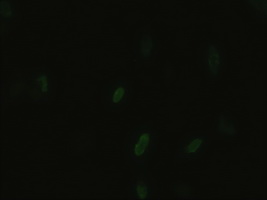
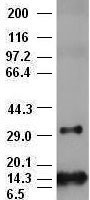
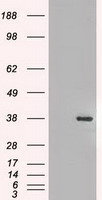
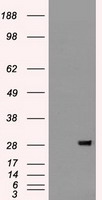
Paraffin Sections (P), Enzyme Immunoassay (E), Western blot / Immunoblot (WB), Functional assay (FN), Frozen Sections (C), Radioimmunoassay (R), Immunocytochemistry/Immunofluorescence (ICC/IF), Immunoprecipitation (IP), Neutralisation (NEUT), Flow Cytometry (F)
Background of FGF basic / FGF2 antibody
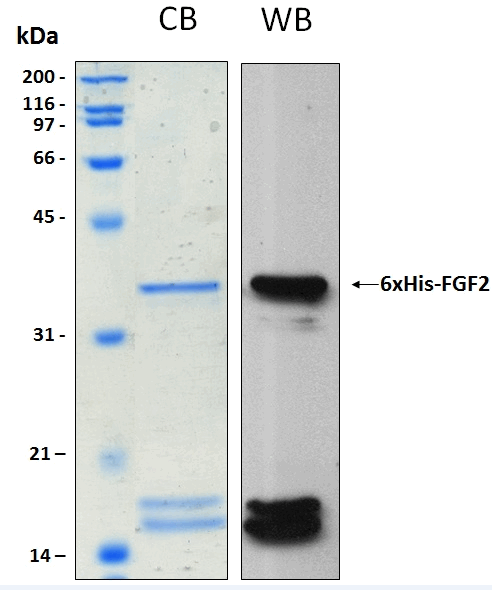
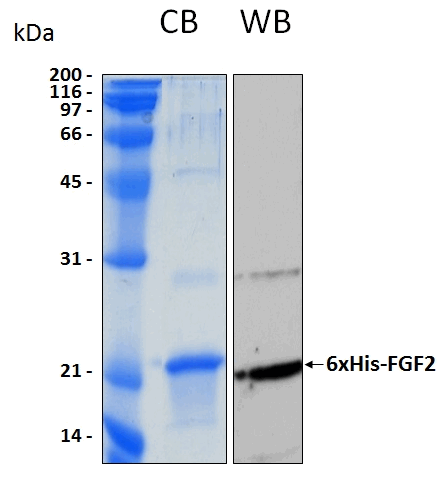
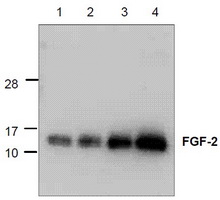
The FGF family is composed of at least 22 polypeptides that show a variety of biological activities towards cells of mesenchymal, neuronal and epithelial origin. All members are heparin-binding growth factors (HBGF). Until the structure of basic fibroblast growth factor (bFGF/FGF-2) was determined, a number of synonyms was used to describe this growth factor. As is often the case, the nomenclature reflected the observed activities reported by individual groups. Basic FGF has been reported as leukemia growth factor, macrophage growth factor, endothelial growth factor and tumor angiogenesis factor. The eventual isolation and characterization of bFGF was done from soluble brain extracts. bFGF was found to have a molecular mass of 16 kDa and to be 154 amino acids in length. Interestingly, bFGF contains no hydrophobic leader sequence previously thougth to be required for cell secretion. Basic FGF bears 55% homology to acidic FGF and also seems to exist in three forms: the 154 amino-acid form and two other truncated versions of 146 and 131 amino acids lacking the N-terminal 9 and 24 residues. Acidic and basic FGF compete for the binding to 125 kDa and 145 kDa receptor species. However, acidic FGF has a higher affinity for the 125 kDa species, while basic FGF has a higher affinity for the 145 kDa species. FGF receptor activation leads to the activation of MAP kinase and protein kinase C. FGF's induce the proliferative response in cells derived from mesoderm and neuroectoderm. It seems that basic FGF reduces the average doubling time by shortening the G1 phase of the cell cycle. Furthermore, it has been reported to induce the release of plasminogen activator by endothelial cells. Perhaps one of the most potentially significant applications of bFGF is related to its reported ability to induce angiogenesis.
General readings
Nakayama T., et al. (2007) Blood. 109(2):1363-72.A E Eriksson., et al. (1991) PNAS. 88: 3441-3445


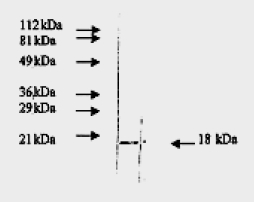
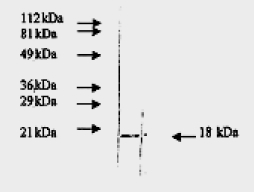
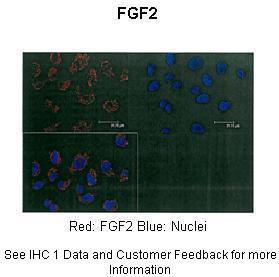
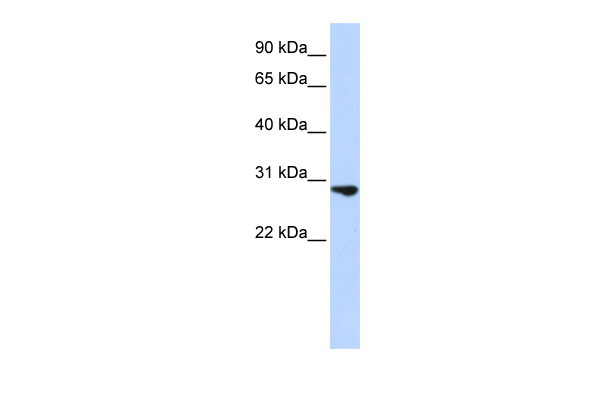







Primary Antibodies
| Catalog No. | Host | Iso. | Clone | Pres. | React. | Applications | |
|---|---|---|---|---|---|---|---|
| DP3506 | FGF basic / FGF2 antibody |
||||||
 |
Rabbit | Azide Free | Hu | FN, WB |
0.2 mg /
$290.00
|
||
| OriGene Technologies GmbH | |||||||
 +2 additional images +2 additional images |
|||||||
| DP3506S | FGF basic / FGF2 antibody |
||||||
|
Rabbit | Azide Free | Hu | FN, WB |
0.1 mg /
$230.00
|
||
| OriGene Technologies GmbH | |||||||
| +2 additional images |
|||||||
| PP1007P1 | FGF basic / FGF2 antibody |
||||||
 |
Rabbit | Aff - Purified | Hu | E, FN, P, WB |
50 µg /
$250.00
|
||
| OriGene Technologies GmbH | |||||||
| +1 additional image |
|||||||
| PP1007P2 | FGF basic / FGF2 antibody |
||||||
|
Rabbit | Aff - Purified | Hu | E, FN, P, WB |
0.1 mg /
$340.00
|
||
| OriGene Technologies GmbH | |||||||
| +1 additional image |
|||||||